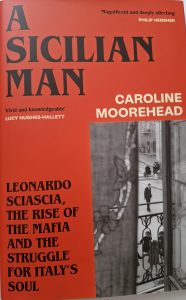
This is an important book which, through the life and works of Leonardo Sciascia, shines a spotlight onto the dark heart of Italy. As Saviano noted, “Italy is a country where appearance is everything but the truth is something else”. Caroline Moorehead, via Sciascia, has revealed more of the truth than most writers on Italy.
Sciascia (1921-89) was born in Racalmuto, an impoverished town in western Sicily. He grew up surrounded by corruption and mafia violence witnessing how those in power controlled the countryside. Racalmuto, for him, became a metaphor for Sicily as a whole where organised crime permeated normal life. He lived through the turbulent times of modern Italy from the Fascist era to WWII and the invasion of Sicily by the Allies to the expansion of the Sicilian mafia and its challenge to the Italian state. As a student Sciascia immersed himself in literature, especially the great French writers, and grew up to become a teacher and a lawyer. But his vocation was to be a writer and during his lifetime he produced a substantial body of work including thrillers, historical novels, investigative studies and numerous essays.
He made his name with the publication of “Il giorno della civetta” (“The Day of the Owl”) in 1961. It was a thriller in which an honest police inspector tries to solve the mystery of a series of murders of judges. When he stumbles upon the truth he is blocked by his superiors. In the novel, Sciascia describes a corrupt system in which businessmen, politicians and criminals work together. It was the first time that the mafia methods and connections were made public and the book caused a sensation in Italy. It was also prophetic, for Sciascia foresaw mafia corruption invading the Italian mainland in his famous phrase: “the palm tree line that is moving from south to north”.
Two more thrillers followed, “A ciascuno il suo” (“To Each his Own”) in 1966 and “Il contesto” (“Equal Danger”) in 1971, the latter being made into a film called “Illustrious Corpses” by Francesco Rosi. In the film, the actor Lino Ventura stars as the policeman discovering secrets that his superiors want to remain hidden, a situation faced by many officers of the law in this period. Fact merged with fiction, for while Sciascia was writing “Il contesto”, a judge was murdered in Palermo. “I started writing with pleasure”, he noted, “but by the end I was no longer enjoying myself”.
The appeal of these books was strengthened by Sciascia’s writing style. In contrast to many Italian authors, he wrote in a concise and lucid manner, using everyday language. Although he created a world of his own in his novels, they were mostly short, none of the above over 135 pages in their original editions. It was no coincidence that Sciascia’s favourite English author was Graham Greene.
Sciascia was always engaged in politics, speaking up whenever he encountered corruption. For a short while he served as a Communist MP in the government in Rome. His condemnation of corruption in high places came to a head following the kidnap and murder of Aldo Moro, a Christian Democrat politician and ex-prime minister, by the Red Brigades. In “L’Affaire Moro” (1978) he pointed his finger at the government which had refused to negotiate with the terrorists while ineffectively, some said deliberately, failing to discover Moro’s whereabouts. Through this and his other campaigns Sciascia became a national figure representing the search for justice and the truth.
Moorehead is an experienced biographer, knows Italy well, and had the co-operation of the Sciascia family in writing this book. The result is a stimulating and instructive read both on Sciascia himself and on the environment in which he lived. It describes how many of Italy’s senior law enforcement officers were assassinated with the connivance of the State. Few authors have described in such depth the dark forces at work in Italy. Sciascia would have approved.